

What’s that !? Stickers on import vehicle from Japan

Meaning stickers on front screen.
So many vehicles are exported from Japan to the world. Have you ever seen stickers on the windscreen / body writing something in Japanese? Those stickers tell so many things to you.
How many times did the car have maintenance?
When was the inspection due?
Where is the car from? and so on…
Let’s see the meaning of stickers on vehicles from Japan.
Stickers on front screen

These are 2 types of stickers on the front screen. the square stickers on the center of front screen is “車検標章” Shaken-hyoushou sticker. Shaken is the Japanese vehicle inspection. Vehicles for daily use have to take the inspection once every 2 years. Vehicles for business have to take once a year. The number on the sticker means the due of Shaken. The small number tells you the year e.g. 33 = 2021. The big number number tells the month e.g. 3 = March. In Japan, all vehicles are required to take shaken to run on public roads. If the driver drives a car without shaken, the driver will be imprisoned for the maximum 1.5 year or fined maximum 800,000 yen. The round one on is “定期点検ステッカー” Teiki-tenken sticker. In addition to the shaken, Teiki-tenken (another inspection once a year) is prefered in Japan. However the teiki-tenken is not a legal obligation. If you see the teiki-tenken sticker on a front screen, the vehicle has got enough maintenance records.
Japanese imperial year
Japanese imperial year has been changed from Heisei (平成) to Reiwa (令和) in 2019. Rei (令) means “Beautiful”, “Good”, and “Order”. Wa (和) means “Harmony” and “Peace”. The era “Reiwa” stands for Japanese wishing beautiful world in peace.

Stickers on rear screen

The round sticker on rear screen is “保管場所標章” Hokanbasho-hyoushou. It means a parking place certificate. In Japan, people cannot purchase vehicles unless you find a parking spot. Most roads are prohibited to park cars. Thus drivers have to get a parking space to own cars. The average cost to park a car a month is around 10,000 – 30,000 yen in a city. The name of the city/area is written on the certificate, thus you are able to notice where the vehicle comes from if you can read Japanese characters.
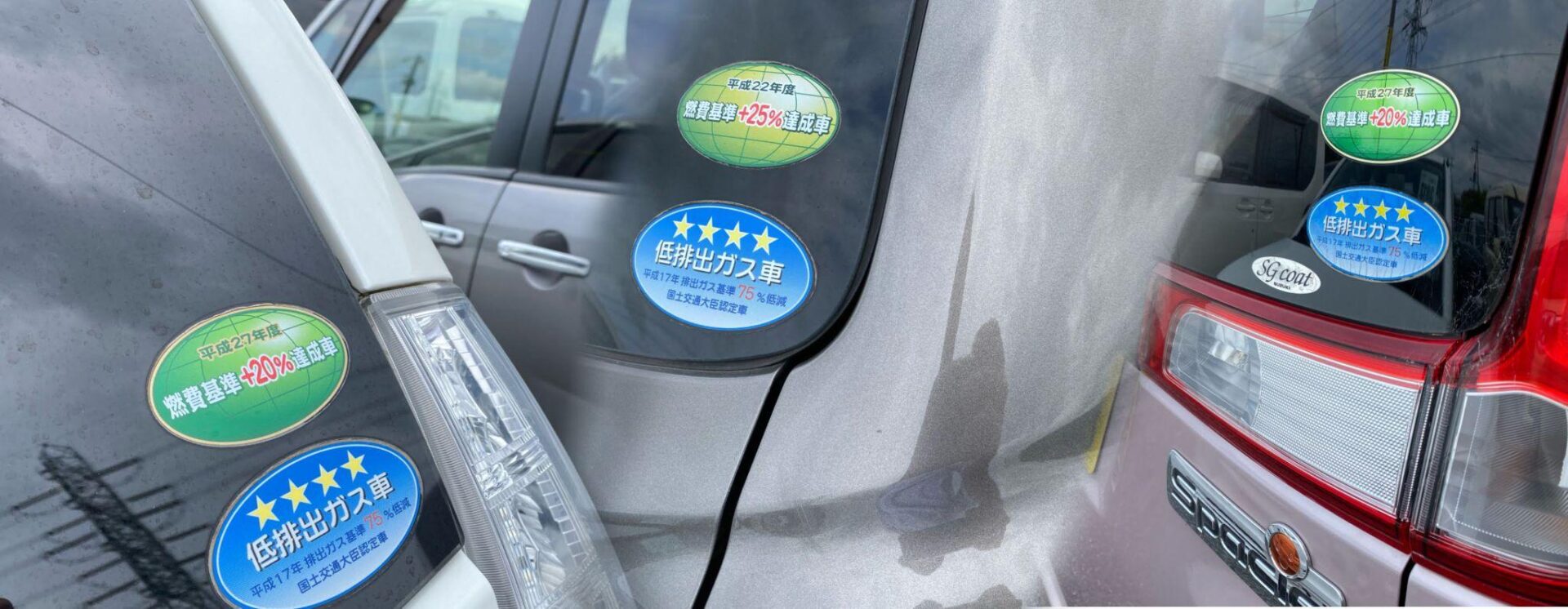
These oval stickers are the result of fuel economy standards and exhaust tests. These stickers show which standards/regulations the model has passed. Green sticker shows you the fuel economy standard by percentage. If the percentage is higher, the fuel economy is better. Blue sticker shows you the result of exhaust tests for the model by stars. There are only 2 types such as 3 stars or 4 stars. Unfortunately, these stickers are unpopular for Japanese drivers. especially young drivers tend to remove these stickers before dating.
To sum up, stickers on Japanese vehicles show you some information such as maintenance records, shaken due, fuel economy, and place vehicles come from. When you buy a Japanese import vehicle, you better take a look at these stickers.
Follow us to drive
